

Different formats from dozens of suppliers
Different fields, different names, different table structures.
A steel-trading company used to retype hundreds of certificates into the ERP by hand. Today the system extracts the data, compares it against the standard, flags risks and the operator mainly handles exceptions.
The operator stopped retyping and started validating. AI extracts structured data, automation compares it against the standard and the original PDF and flags risks.
The workflow handles different suppliers, multiple certificates in one PDF and multilingual documents. Behind every extraction is an audit trail: what was in the source, what was in the standard, what ended up in the output and why.
of manual work saved daily
average certificate processing time
accuracy on key fields
suppliers with automatic detection
Text PDFs · 95+ score · 0 HIGH warnings → candidate for auto-approve.
Favex is a trading company in the steel segment. It receives hundreds of material certificates each month from dozens of different suppliers - each with a different format, structure and language. The operator retyped every certificate into the ERP by hand. Each day this cost 4+ hours of routine work.
Different fields, different names, different table structures.
CZ, DE, EN, IT and their combinations in one PDF.
The operator had to split the document into individual certificates by hand.
Hundreds of entries a day - mistakes from lapses in attention.
The workflow rested on a handful of experienced operators.
For a given decision there was no way to trace back what had been in the source.
The PDF next to the form, pre-filled fields, mismatches highlighted in colour. For certificates without issues, a single confirmation is enough.
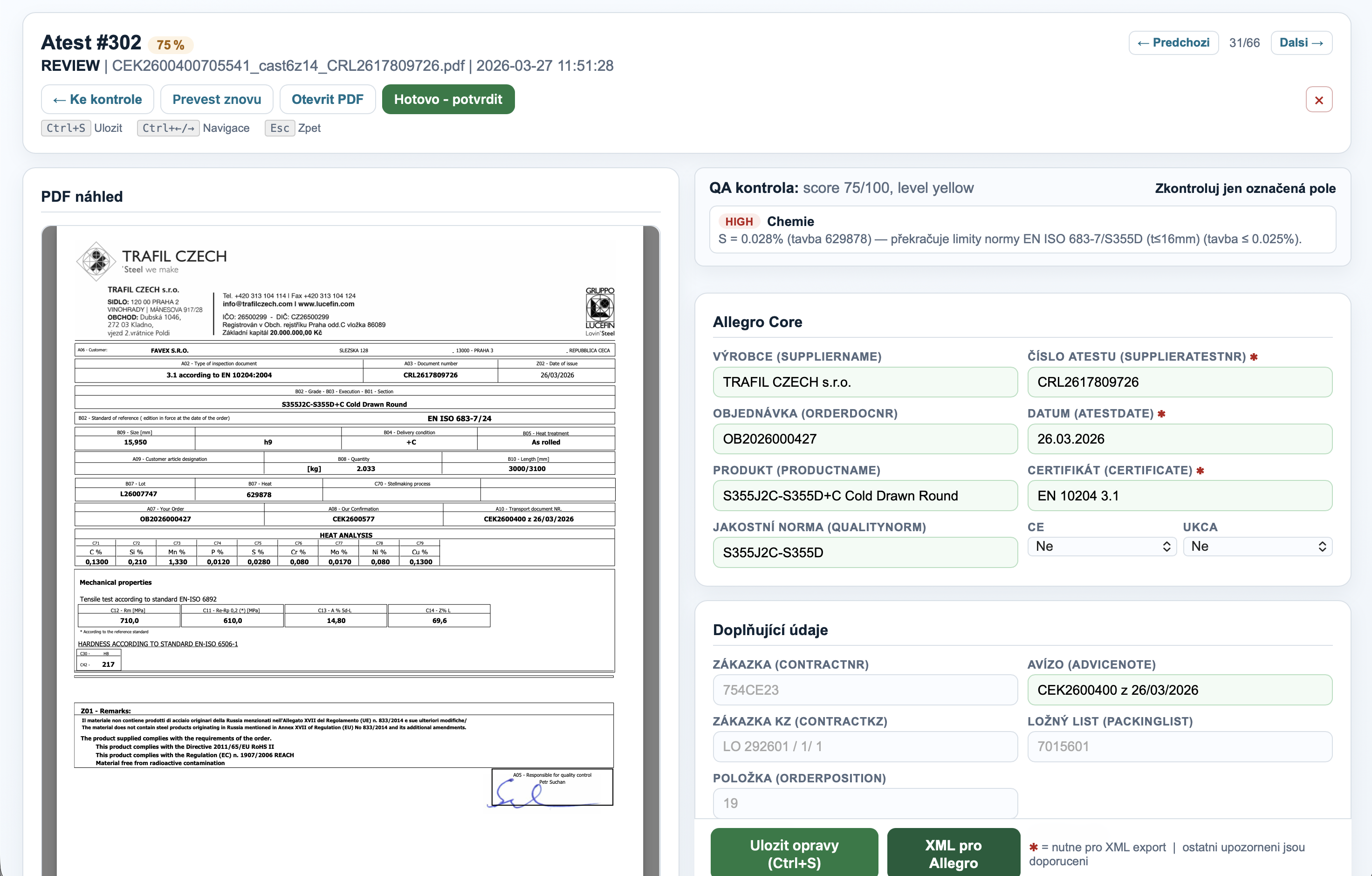
We designed an end-to-end workflow in which the operator stopped retyping and started validating. Each phase has a clear role: AI extraction, rules for validation, a human at the decision, integration to hand over the data.
Web upload, automatic intake from email (IMAP), batch import of a folder. Multi-certificate PDFs are split automatically into individual certificates. The system detects the supplier and loads the right rule template.
Header fields, chemical analysis, mechanical properties, heat treatment, technical tests and free-text notes in tables. CZ, DE, EN, IT - one flow, no per-language setup.
Every value is compared against the limit values of the standard by steel grade and thickness. Conditional rules and exceptions are applied automatically. Each certificate gets a score of 0–100 and warnings at three levels of severity.
The operator sees the PDF, pre-filled data and mismatches highlighted in colour. For certificates without issues, a single confirmation is enough. The data goes straight into the ERP import format - no intermediate steps, no manual copying.
AI handles different layouts, multi-certificate PDFs and multilingual documents. It keeps its own rules for each supplier - a new one is added as a data template, not a programming task.
Header fields, dimensions, weights, heat numbers, chemical analysis, mechanical properties, heat treatment, technical tests (Charpy, ultrasonic, hardness), markings and free-text notes in tables.
Each supplier has a different format and different field names. The system handles it on its own. A new supplier is added as a data template, not as a programming task.
PDFs with multiple certificates are split automatically. Extraction handles CZ, DE, EN, IT and combinations - one standardised flow, no per-language setup.
The system has the technical standards loaded by steel grade and material thickness. Every chemical value and mechanical property is compared automatically against the limit values - the operator immediately sees what passes and what does not.
Every value is automatically compared against the limit values of the standard. The operator instantly sees what passes and what does not - with no manual searching through technical literature.
Standards contain conditional rules - element ratios, exceptions for certain grades, limits by thickness. The system applies these exceptions automatically and for each one states which note permitted it.
Each certificate gets a score and a list of warnings at three levels: HIGH (physically impossible), MEDIUM (suspicious), LOW (missing). Certificates above 95+ with no HIGH/MEDIUM are candidates for auto-approve.
Next to the form they see the PDF, so they can verify every value against the source. The data is pre-filled, mismatches and exceptions highlighted in colour. For certificates without issues, a single confirmation is enough.
Web upload (drag & drop), automatic intake from email (IMAP with a subject filter), batch import of a whole folder, a built-in PDF splitter for manual splitting.
Pre-filled data, colour highlighting of mismatches, the PDF next to the form for verification against the source. Experienced colleagues step in only where it really needs attention.
Confirmed data goes straight into the ERP import format - no intermediate steps. A REST API is available for other systems. Connecting to reporting is a matter of configuration.
The system runs efficiently without operator intervention and over time refines its extraction based on real corrections. A dashboard shows where it works reliably and where there is room for improvement.
Simple text PDFs go through a faster path, complex scans and multi-certificate documents through a more powerful one. The decision is automatic - operations run efficiently without operator intervention.
Every correction from the operator is recorded. If a field is corrected repeatedly, the system remembers it and extracts it more accurately next time. Quality doesn’t drop over time - it improves.
A dashboard shows processing status, extraction accuracy and the most frequently corrected fields. It’s clearly visible where the system works reliably and where there is room for improvement.
Certificates were the first live use case. We’re currently working with Favex on incoming invoice data extraction - a different domain, but the same principle: a document arrives in different formats from different suppliers, has to be extracted, validated and handed over to the ERP.
We start with how the work actually happens - not with whatever model we happen to have on hand.
What AI does, what a rule does, what an integration does, what a human does - and where the audit trail belongs.
We assess accuracy, error rate, exceptions and impact - not the impression from a demo.
We build for long-term maintenance, quality monitoring and expansion to further processes.